KA131 Student Mobility for Traineeships
Erasmus+ Traineeships at Keela Permaculture Farm
We host Erasmus+ traineeship students at the farm and education centre here in central Portugal. If you are a university student in Europe and want to spend a few months doing practical regenerative agriculture and permaculture work, your own university can fund it.
This page explains how it works, what you would be doing here, and how to set it up. Our host organisation OID is E10340911.
What an Erasmus+ traineeship actually is
Erasmus+ funds work placements abroad, not just study exchanges. The formal name is Student Mobility for Traineeships. The short version:
- You find a host organisation abroad. That is us.
- Your own university approves the placement and gives you a grant.
- You, your university and we sign a document called the Learning Agreement for Traineeships before you travel.
- You come and work here for between 6 and 12 months.
- At the end we sign your Traineeship Certificate and write your evaluation, and your university recognises the placement.
The grant comes from your university, not from us.
If you are a university international officer or internship coordinator, see the section for university coordinators near the bottom of this page.
Who can come
- Students enrolled at any European university that holds an Erasmus Charter for Higher Education. Bachelor, master or PhD.
- Recent graduates, as long as you apply while you are still enrolled and complete the placement within 12 months of graduating.
You do not need to be studying agriculture. Environmental science, forestry, landscape architecture, rural development, biology and sustainable tourism all map onto the work here.
Way 1
Traineeship during your degree, 2 to 12 months
The standard route and the one most people use. You are enrolled, your placement counts towards your studies, and your university recognises it when you get back.
We ask for a minimum of [X months] because it takes a few weeks before anyone is properly useful on a farm and the seasonal work only makes sense over a longer stretch.
Way 2
Recent graduate traineeship, 2 to 12 months
The same placement, done after you graduate. The catch is that you have to apply for it while you are still enrolled, before you finish, and the whole placement has to be completed within 12 months of graduating.
Sort this out in your final semester or you lose the option.
Way 3
Doctoral fieldwork, 5 to 30 days
Short mobility for PhD candidates. If you need a working farm to collect data on soil, biodiversity, carbon, agroforestry or rural livelihoods, this is the route.
Our minimum stay does not apply here. Tell us what you need to measure and we will tell you honestly whether the site suits it.
What you would actually do
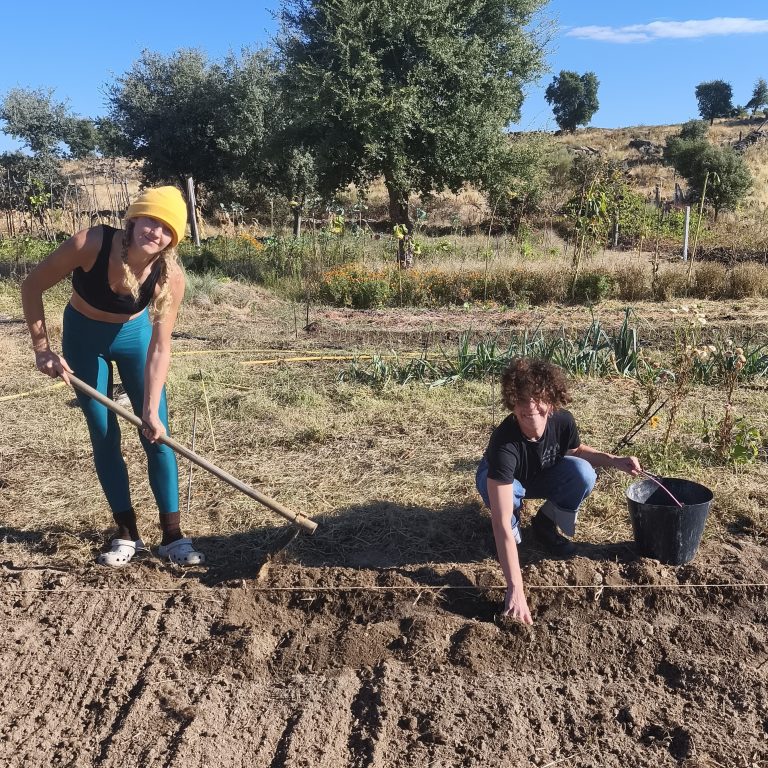
This is a working farm, not a classroom. Each student usually is assigned a tear which is agreed upon when your placement is confirmed. See images and descriptions below.
Depending on the season, general the work covers soil building and composting, tree planting and reforestation, food forest management, water and swale work, animal systems, natural building, nursery and propagation, and the day to day running of the place. You would work alongside us rather than being handed tasks and left alone. We can also shape the placement around a thesis or research project if you tell us early enough. Data collection on soil, biodiversity or carbon is something we would welcome and would help with.
What the grant is worth
Your university pays the grant, not us. The exact amount is set by your own country’s National Agency, so it varies from one university to the next. Only your international office can tell you your real figure. As a rough guide:
- Portugal sits in the lower cost of living group, so published university rates for a placement here generally land somewhere between 480 and 700 euros a month.
- Traineeship rates are usually about 150 euros a month higher than study exchange rates, because you are not getting student housing or a canteen.
- There is a separate travel contribution on top of the monthly amount, with a higher rate if you travel by train, bus or shared car rather than flying.
- Students with fewer opportunities can get roughly 250 euros a month extra. The criteria are set nationally, so ask your international office whether you qualify.
- Most universities pay 80 per cent before you leave and the last 20 per cent after you submit your final report on return.
Be realistic about this. The grant is a contribution towards living costs, not a wage.
What the grant is worth
Your university pays the grant, not us. The exact amount is set by your own country’s National Agency, so it varies from one university to the next. Only your international office can tell you your real figure. As a rough guide:
- Portugal sits in the lower cost of living group, so published university rates for a placement here generally land somewhere between 480 and 700 euros a month.
- Traineeship rates are usually about 150 euros a month higher than study exchange rates, because you are not getting student housing or a canteen.
- There is a separate travel contribution on top of the monthly amount, with a higher rate if you travel by train, bus or shared car rather than flying.
- Students with fewer opportunities can get roughly 250 euros a month extra. The criteria are set nationally, so ask your international office whether you qualify.
- Most universities pay 80 per cent before you leave and the last 20 per cent after you submit your final report on return.
Be realistic about this. The grant is a contribution towards living costs, not a wage.
For university coordinators
This section is for university international officers and internship coordinators.
We host under KA131 Student Mobility for Traineeships (SMT). Our OID is E10340911. No accreditation is required for a host organisation under Erasmus+, but we are happy to provide a company profile, insurance details, the traineeship programme in learning outcome format, and a signed acceptance letter for your files.
If your institution holds KA171 external policy funds and is placing an incoming student from a third country, we can host on that basis as well.
The 2026 Erasmus+ Programme Guide names rural development, sustainable farming, management of natural resources and soil protection as areas for special attention. That is exactly what a placement here consists of.
If your institution runs or works with a mobility consortium, get in touch and we will go through the paperwork with you.
For university coordinators
This section is for university international officers and internship coordinators.
We host under KA131 Student Mobility for Traineeships (SMT). Our OID is E10340911. No accreditation is required for a host organisation under Erasmus+, but we are happy to provide a company profile, insurance details, the traineeship programme in learning outcome format, and a signed acceptance letter for your files.
If your institution holds KA171 external policy funds and is placing an incoming student from a third country, we can host on that basis as well.
The 2026 Erasmus+ Programme Guide names rural development, sustainable farming, management of natural resources and soil protection as areas for special attention. That is exactly what a placement here consists of.
If your institution runs or works with a mobility consortium, get in touch and we will go through the paperwork with you.
How to apply
Complete the application form which will tell us who you are, what you are studying, when you want to come and for how long, and what you want to get out of it. Tell us your university and whether you have already spoken to your international office.
Then speak to your international office. Their internal deadlines are usually earlier than you expect, often in the spring for placements starting the following autumn, so start early.
What is still being set up
We are taking our first Erasmus+ trainees, so the placement programme will get better with each group. Tell us what is not working while you are here.
We are still finalising the insurance and paperwork side with a few universities. If yours has requirements we have not seen before, send them and we will work through them.
Permaculture Design Course Portugal
Your host and mentor
Laurence Manchee
PDC Lead Teacher
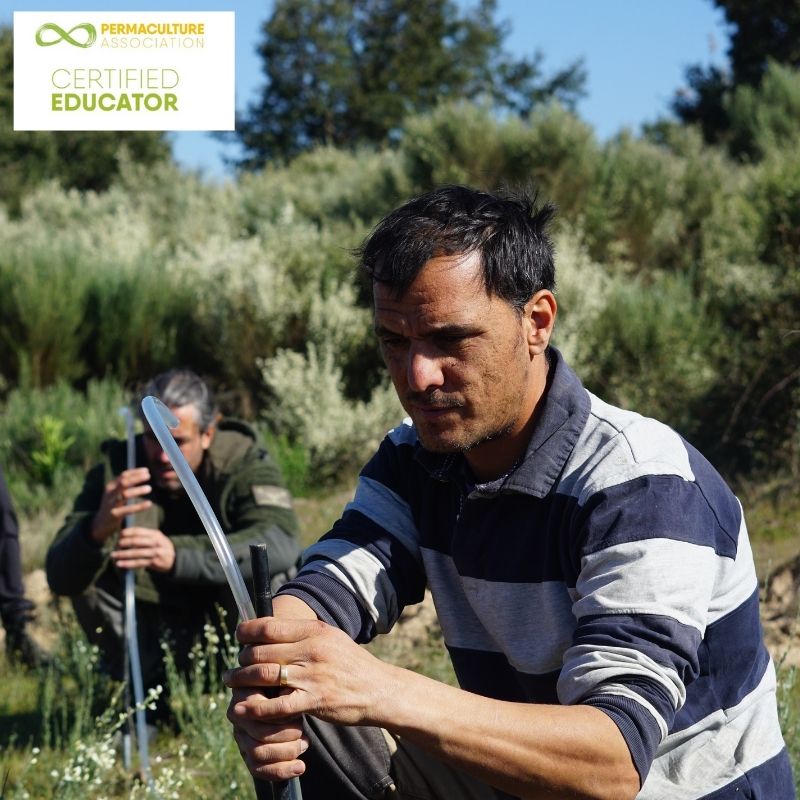
Co-founder of Keela Permaculture Farm. Laurence is certified by the Permaculture Association to teach certified PDCs. An author in Permaculture Magazine and teacher of Agroforestry, Permaculture Design and Natural Building Courses. Laurence will be the lead teacher on all courses. Laurence has lived a permaculture life at Keela since 2016. He is a farmer, shepherd, gardener, builder and homesteader.
What our past students have said
Google and Facebook Reviews
Join the mailing list
Don’t miss out on this opportunity to gain the knowledge and skills needed to create sustainable systems that benefit both people and the environment. Find our about courses, new blog posts and new opportunities.
Please sign up here to get more info