Join us in central portugal for your Erasmus program at our permaculture project
Three EU Routes to Visit Keela Permaculture Farm: Erasmus, Erasmus+, and Erasmus for Young Entrepreneurs
If you’re based in Europe and dreaming of spending time on an off-grid permaculture farm in Portugal, there’s a good chance you don’t need to pay your own way — or even take unpaid leave. The EU runs three different mobility schemes that people often lump together under “Erasmus,” but they serve very different visitors and open very different doors. Here’s how each one works, and which might get you to the farm.
1. Erasmus (the original student exchange)
This is the one everyone’s heard of: university students spending a semester abroad. It’s run through your home university’s international office, not something a farm can offer directly. For most people wanting hands-on time in Beira Baixa, classic Erasmus isn’t the right fit — but if you’re a student on an agriculture, environmental science, or rural development degree, it’s worth asking your Erasmus coordinator whether a placement or internship stay is possible under the traineeship strand. That traineeship option actually sits under Erasmus+, which brings us to the next route.
2. Erasmus+ (the broader umbrella)
Erasmus+ is the EU’s larger funding programme covering education, training, youth, and sport — and it goes well beyond university exchanges. Get the course costs at keela covered or get paid to volunteer here! You must be under 30. Two strands are especially relevant to a working farm:
- Vocational Education and Training (VET) mobility — trainees and apprentices from vocational schools or colleges can do a work placement abroad, fully funded for travel and living costs. If you’re enrolled in a course related to agriculture, horticulture, sustainability, or land management, this is often the most direct route to a funded stay.
- Youth mobility and adult education strands — these support group exchanges, training courses, and staff mobility for people working in youth or adult education settings, which can include short, structured visits to demonstration farms and regenerative land projects.
The catch with Erasmus+ is that individuals can’t apply solo — a sending institution (a school, college, VET provider, or youth organisation) has to apply for the funding and arrange the placement with a host. If you’re already connected to one of these institutions, ask them directly whether they have an Erasmus+ mobility budget and whether a placement at a permaculture farm would qualify.
3. Erasmus for Young Entrepreneurs (EYE) — the route built for exactly this
This is the scheme most likely to bring an independent, self-directed visitor to the farm, and it works completely differently from the other two. Get paid €850 per month by the EUR to work at keela and no age limit
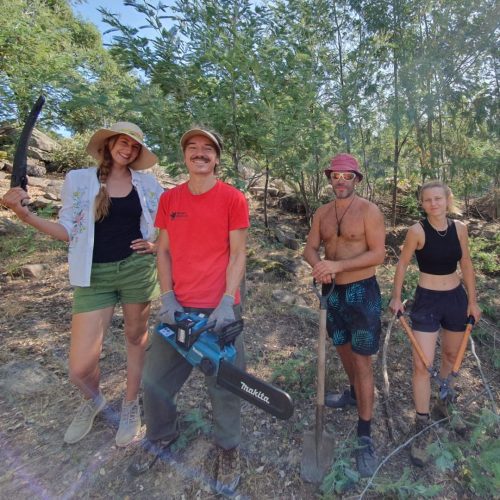
EYE connects new or aspiring entrepreneurs with experienced host entrepreneurs already running small businesses in another participating country, for a stay of one to six months. Rather than sitting in a classroom, the new entrepreneur works alongside the host on real, concrete business projects — in our case, that means the actual daily work of running a regenerative farm: soil building, water systems, land regeneration, course delivery, and the practicalities of running a farm-based enterprise.
A few things make EYE particularly appealing:
- It’s funded. The EU offers financial support to help cover travel and subsistence costs, so the exchange doesn’t come out of your own pocket. You will get €850 +er month
- It’s genuinely reciprocal. The idea is to help the host research, develop, and test new business ideas — the new entrepreneur brings fresh perspective from a different national and market background, so it’s not a one-way volunteer arrangement; you’re expected to contribute ideas, not just labour.
- It has a strong track record. Between 2009 and 2024, the programme facilitated over 12,000 business exchanges across more than 45 countries, and 98% of new entrepreneurs say they’d recommend it, with 92% staying in touch with their host afterwards.
Keela Permaculture Farm is a registered Host SME under EYE, with the British-Portuguese Chamber of Commerce (BPCC) acting as our Intermediary Organisation. In practice, that means:
- You get in touch with an Intermediary Organisation in your own country (every participating country has one — eligible entrepreneurs are matched between new and host participants across the network).
- You put together a short business plan or project idea related to sustainable land use, regenerative agriculture, or rural enterprise.
- Once matched, the BPCC helps coordinate the logistics on the Portuguese side, and you come and work directly with us on the farm.
One thing worth flagging: the call for proposals that selects Intermediary Organisations is aimed at organisations, not individual entrepreneurs — so as a prospective participant, you don’t apply to that call yourself. Instead, you reach out to an existing Intermediary Organisation in your country and ask about current openings; they handle the matching and paperwork on your behalf.
Which one is actually for you?
- Still studying, on a related degree? Ask about a traineeship under Erasmus / Erasmus+.
- Enrolled in vocational training or working in youth/adult education? Ask your institution about Erasmus+ VET or adult education mobility.
- An aspiring entrepreneur with an idea related to farming, land regeneration, or rural business — and want a properly funded, months-long stay with real project work? EYE is almost certainly your route, and it’s the one we can help with directly.
If EYE sounds like the right fit, get in touch with your national EYE Intermediary Organisation and mention Keela Permaculture Farm as a potential host — or reach out to us directly and we can point you toward the BPCC.